
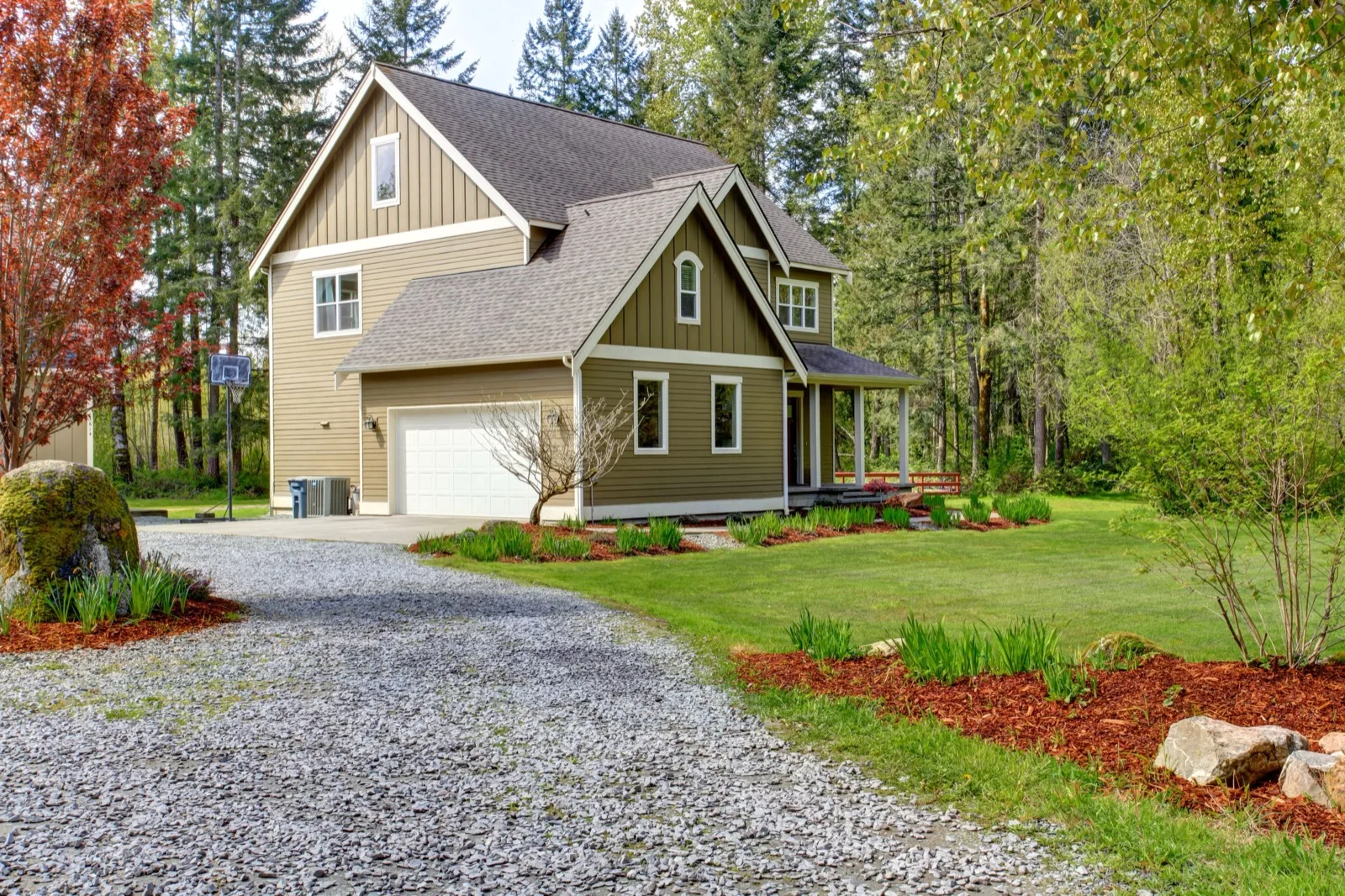
How much does a gravel driveway cost in Louisiana?
A gravel driveway costs about $1.25 to $4.00 per square foot installed in 2026, which puts a typical residential drive at $1,800 to $3,500. Soft ground that needs fabric and a real base pushes the rate to $4 to $10 per square foot. On a long rural drive, the rock alone can cost more than an entire suburban driveway.
Those are market numbers, not our price list. Every gravel driveway we build gets priced off the ground itself, because the subgrade decides how much base it needs. The ranges below, and the live Hammond rock prices, are for budgeting.
What a gravel driveway costs by size
Length times width gives you square feet, and square feet times the rate gives you the budget. Here is how the published examples scale.
| Driveway | Published installed cost |
|---|---|
| Two car pad, 24 by 24 feet | $1,000 to $2,200 |
| 100 feet by 10 feet | about $2,000 |
| 400 feet by 12 feet (our math at $1.25 to $4.00) | $6,000 to $19,200 |
| 528 feet by 16 feet private road | $10,600 to $33,920 |
| 1,000 feet by 12 feet (our math) | $15,000 to $48,000 |
| Any size, soft ground with full stabilization | $4 to $10 per square foot |
Sources: HomeAdvisor, Fixr, Inch Calculator and Bob Vila. The lines marked our math are the published per square foot rate applied to that size, not a quote.
Width is a lever you control. Twelve feet is standard for a residential drive. A 20 foot wide drive costs two thirds more in rock than a 12 foot one over the same length.
What rock costs around Hammond right now
Gravel pricing is local, because rock is heavy and the haul from the pit is most of the price. Here is a delivered menu for Hammond 70401 from an online aggregate marketplace, pulled in August 2026. These are starting prices for delivered loads. A contractor buying at the pit pays less.
| Material, delivered to Hammond | Starting price per ton |
|---|---|
| Limestone 610, 3/4 inch minus | $64.80 |
| Limestone 73 DOT | $67.50 |
| Crusher run, 1 inch minus | $54.00 |
| Commercial base, 3/4 inch minus | $40.50 |
| Recycled concrete 53, 1.5 inch minus | $38.48 |
| Recycled concrete, 3 inch minus | $36.45 |
| Screened asphalt millings | $56.70 |
Source: Aggregate Markets, Hammond product listing.
The gap between limestone and crushed concrete is the number to remember. Recycled concrete runs about 40 to 44 percent less per ton at the same address. Suppliers across south Louisiana sell it under the 610 name as the budget substitute for driveway and pad base.
Why is limestone expensive in south Louisiana?
Because it is not from here. A USGS atlas of the Lake Pontchartrain basin counted the aggregate mines by watershed. The Tangipahoa watershed had 27 sand and gravel mines and zero crushed stone mines. Amite, Bogue Chitto and the Lower Pearl were the same: plenty of sand and gravel, no stone. The only crushed stone producers in the whole basin were in the Mississippi delta, and USGS notes most of the product is imported from other regions.
Louisiana has sand and gravel in quantity. What it lacks is hard rock. Limestone comes in by truck and barge, and the price shows it. Crushed concrete is crushed locally from torn out slabs and driveways, which is why it lands so much cheaper.
The math on a 20 by 400 foot driveway
Twenty by 400 is 8,000 square feet. At $1.25 to $4.00 per square foot, budget $10,000 to $32,000 installed. If the ground is soft enough to need fabric, a dig out and a thick base, the $4 to $10 band puts it at $32,000 to $80,000. That spread is why a site visit exists.
Now the rock. At 4 inches compacted, 8,000 square feet needs about 99 cubic yards of finished depth, or about 110 yards ordered to allow for compaction. That is roughly 135 to 155 tons. At 6 inches it is about 148 yards finished, 165 ordered, or roughly 210 to 235 tons.
Price that at the Hammond menu. Six inches of 610 limestone at $64.80 a ton is about $13,600 to $15,100 in rock. The same depth in recycled concrete at $38.48 a ton is about $8,100 to $9,000. Either way it is 14 to 16 tri axle loads, or 15 to 21 tandem loads.
One more line: at half an inch of crown per foot of width, a 20 foot drive sits 5 inches higher at the centerline than at the edges. That is the shape that keeps it out of the mud.
What keeps a gravel drive out of the mud here
Hammond averages 64.2 inches of rain a year over 116 days with measurable rain, according to NOAA’s 1991 to 2020 climate normals. A driveway here has to shed water 116 days a year. Rock dumped on dirt does not.
A gravel drive is two layers. The base is larger, well graded stone that drains, with few fines. The surface is smaller rock with enough fines to pack and shed water. Consumer guides put 4 inches as the bare minimum and 8 to 12 inches as the recommended total for a driveway.
Then the crown. Half an inch of rise per foot of width, so a 12 foot drive is 3 inches higher in the middle than at the edges. A flat drive lets water puddle. Puddles become potholes. Every tire through a pothole throws out the fines that bind the surface, and standing water soaks the base and softens it. Crown stops that chain at the first step, and traffic flattens it over time, so it gets recut.
On soft ground, woven geotextile fabric under the base does two jobs: it keeps the wet soil below from pumping up into the clean rock, and it spreads the load. It can cut the base thickness needed, which can pay for itself in rock. It needs a 2 to 3 foot overlap and at least 6 inches of cover.
Two mistakes we see most. Clean single size stone, like number 57, as the driving surface. It looks good the day it goes down and rolls out from under tires after. And fresh rock on a soft, rutting drive. If the base holds water or is too thin for the load, more rock on top does not fix it. Regrading the drive and grading the ground beside it so water leaves is the fix.
Gravel versus concrete versus asphalt
Gravel wins the front end by a wide margin. Installed per square foot: gravel $1.25 to $4.00, asphalt $7 to $15, concrete $8 to $20. Average totals in the guides run $1,800 to $3,500 for gravel, about $5,300 for asphalt and about $6,400 for concrete. On a 400 by 12 foot drive, gravel is roughly $6,000 to $19,200 and concrete at $8 to $20 per square foot is roughly $38,400 to $96,000.
Gravel gives some of that back in upkeep. It needs fresh rock and a recut crown over the years. But a maintained gravel drive can last decades, against 15 to 20 years for asphalt with sealcoating every few years and roughly 27 years for concrete. On 64 inches of rain, a slab poured on soft subgrade cracks anyway. A gravel drive with base and crown can be regraded. A cracked slab cannot.
What we need to quote your driveway
Send the address, the length and width you want, and a photo of the ground it crosses. Tell us if it stays wet after rain, and whether it is a new drive or an old one that has gone soft. If the drive needs to be built up, our fill dirt cost guide covers that part. The estimate is free.
Call or text J-Rod’s Dirt Work at (985) 500-4145, or send the form.
Sources used for the ranges above: HomeAdvisor, Fixr, Inch Calculator, Bob Vila, LawnStarter, NerdWallet, Aggregate Markets (Hammond listing and gravel cost guide), Acadiana Shell and Limestone, LA Landscape Supply, Barrel Industries, the Maine DEP gravel road manual, the USGS Lake Pontchartrain basin aggregate atlas, NOAA 1991 to 2020 climate normals for Hammond and Stone Centers’ gravel calculator.