
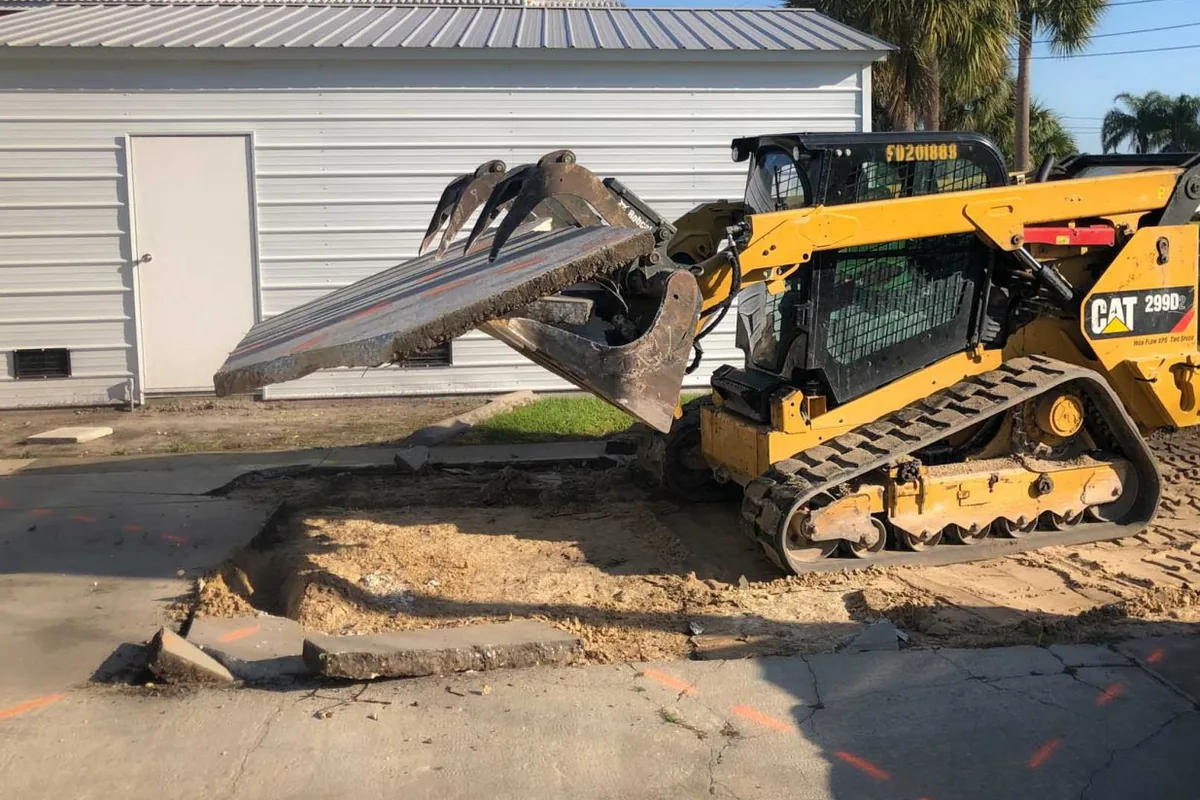
How much does concrete removal cost in Louisiana?
Concrete removal runs about $2 to $7 per square foot in 2026 national cost guides. Two guides put a driveway between $1,140 and $4,500. A small 10 by 10 foot slab runs $300 to $800.
Those are published national ranges, not J-Rod’s Dirt Work prices. We do concrete removal out of Hammond, and the real number comes off your concrete. Two things drive it most: how much concrete there is, and what is inside it.
The job is breaking the concrete up, loading it and hauling it off. We leave bare dirt, graded for whatever comes next. Pouring new concrete is another trade’s work.
What does concrete removal cost per square foot?
LawnStarter puts concrete removal at $2 to $7 per square foot, breaking and disposal together. Plain concrete sits at $2 to $4. Concrete with rebar or wire mesh runs $4 to $7.
| Concrete area | Plain concrete ($2 to $4 per sq ft) | With rebar or mesh ($4 to $7 per sq ft) |
|---|---|---|
| 100 square feet | $200 to $400 | $400 to $700 |
| 200 square feet | $400 to $800 | $800 to $1,400 |
| 400 square feet | $800 to $1,600 | $1,600 to $2,800 |
| 600 square feet | $1,200 to $2,400 | $2,400 to $4,200 |
| 1,000 square feet | $2,000 to $4,000 | $4,000 to $7,000 |
Math on LawnStarter’s 2026 per square foot rates. Small jobs often land above these lines.
Size still changes the rate. HomeGuide notes that smaller jobs cost more per square foot than large ones. Machine work usually carries a one day minimum, too.
What does it cost to remove a driveway, patio or slab?
Cost guides also price removal by the job. Driveways sit near the top of the list. HomeGuide says a driveway costs more to break up than a slab, because the job needs an excavator.
| Job | LawnStarter | HomeGuide |
|---|---|---|
| Driveway | $1,140 to $3,000 | $1,200 to $4,500 |
| Patio | $900 to $2,700 | $1,200 to $3,000 (20 by 20 feet) |
| Slab | $625 to $1,700 | $300 to $800 (10 by 10 feet) |
| Sidewalk | $850 to $2,090 | $750 to $1,250 (50 feet long) |
| Steps | $275 to $625 | $250 to $500 |
| Garage floor | not listed | $1,000 to $3,500 (2 car garage) |
| Foundation | $2,500 to $7,500 | not listed |
Sources: LawnStarter and HomeGuide.
Foundations are the biggest line. After a house comes down, the slab and the footings stay in the ground. Footings are the thick concrete under the walls, and they sit deeper than the slab. LawnStarter puts foundation removal at $2,500 to $7,500.
Pulling a slab after a teardown is part of demolition work. Our house demolition cost guide covers the rest of that bill.
Sidewalks tend to go faster. HomeGuide notes that most sidewalks are not reinforced, which cuts labor time. A patio costs more when it is attached to the house or has other masonry built into it.
How do thickness and rebar change the price?
A typical house slab is about 4 inches thick. Commercial concrete often runs 6 to 8 inches. Thicker concrete creates heavier debris, and it fills a hauling truck faster.
LawnStarter keeps 4 to 6 inch slabs inside its normal $2 to $7 range. Past 6 inches, it says costs often double. The concrete has to be cut into smaller pieces, which takes more labor and equipment.
Steel is the other big swing. Rebar and wire mesh have to be cut out, and the steel has to be disposed of too. HomeGuide adds $1 to $3 per square foot for reinforced concrete.
Run the math on a 400 square foot patio. With no steel, LawnStarter’s $2 to $4 rate comes to $800 to $1,600. With rebar at $4 to $7, the same patio comes to $1,600 to $2,800.
Machine or jackhammer: which one fits your job?
HomeGuide says contractors break concrete with a jackhammer or an excavator, depending on the size and thickness. It says slab removal typically takes both a jackhammer and a concrete saw. Driveways and slabs thicker than 4 inches call for heavier equipment.
Hand work costs time. HomeGuide lists labor at $50 to $100 per person per hour. When a machine cannot fit through a back gate, the work switches to hand tools. That means extra labor and extra time.
Bob Vila puts companies with a mini excavator or skid steer at $100 to $300 per hour. HomeGuide says most slabs take 1 to 2 days.
We match the machine to the space. The tracked skid steer works the tight spots, and the excavator takes heavy slabs and footings.
What does hauling and disposal cost?
Concrete is heavy. A cubic yard weighs about 4,000 pounds, and landfills charge by weight. LawnStarter lists disposal at $51 to $100 per ton. HomeGuide lists dump fees at $90 to $160 per ton.
Here is the math on a 20 by 20 foot patio, 4 inches thick. That is about 5 cubic yards of concrete, close to 10 tons. At LawnStarter’s $51 to $100 per ton, landfill fees alone would come to about $510 to $1,000.
Recycling cuts that line. LawnStarter says many recyclers take concrete debris free of charge or for a small fee. The concrete gets crushed and reused as road base and gravel fill.
Around Hammond, crushed concrete is sold for road and driveway bases, with bulk delivery across Tangipahoa Parish. The parish recycling center is not the place for broken concrete. Tangipahoa lists building materials as not accepted there.
Do you need a permit to remove concrete in Louisiana?
Sometimes. HomeGuide says you need one when the concrete sits in the public right of way. Published permit fees run $38 to $300 at LawnStarter and $50 to $400 at HomeGuide. Parish fees are set locally, so ask the office.
A flood zone changes the answer. Federal rules count filling, grading and excavation as development. LSU AgCenter states that all development in a special flood hazard area requires a permit. Pulling a slab and then filling or regrading the spot falls under that.
Tangipahoa Parish does flood determinations through its Permit Office in Hammond, at (985) 542-2117. Call before any machine shows up, since the answer depends on where your lot sits.
Utilities get located before any digging. Louisiana law requires notice to the regional notification center at least 48 hours ahead. The same law caps it at 120 hours, weekends and holidays excluded. Locate requests are free at 811 or 1-800-272-3020. Gas pipes and electrical conduit can run right under a slab.
What comes after the concrete is gone?
Pulling concrete leaves a low spot. Old flatwork sits on a base of sand or gravel, and that base comes up with it. So the hole ends up deeper than the slab was thick. A shallow spot just needs grading. A deeper one needs dirt brought in and packed down.
HomeAdvisor puts fill dirt at $5 to $30 per cubic yard and leveling at $1 to $2 per square foot. Our fill dirt cost guide covers per yard and per load pricing. We sell and haul fill dirt too, so the dirt and the removal can land on one bill.
Some people skip new concrete. A cracked drive can come back as gravel, and our gravel driveway cost guide covers that price. We build gravel driveways too. If new concrete is the plan, we leave the ground graded and ready for whoever pours next.
What pushes concrete removal cost up around Hammond?
Rain is the first thing. Hammond averages 64.2 inches of precipitation a year, spread over about 116 days. Wet ground is soft ground. Loaded trucks rut a soaked yard, so wet weeks can push a removal back.
The rest of the money goes here:
- Size. More square feet means more machine hours and more tons to haul.
- Steel. Rebar or mesh adds $1 to $3 per square foot in HomeGuide’s numbers.
- Thickness. Past 6 inches, LawnStarter says costs often double.
- Access. A tight backyard means a smaller machine or hand work, plus more trips to the truck.
- The haul. HomeGuide notes mileage fees when concrete travels farther to be dumped.
- What comes next. Fill dirt, grading or new gravel adds its own line.
How do you get a real number for your concrete?
Send us the address, the rough size of the concrete and a photo or two. A shot of the way in helps, since access moves the price. We will look at the job and give you a free estimate on the concrete removal work. Call or text (985) 500-4145, or send the form on our contact page.
Sources used for the ranges above: LawnStarter, HomeGuide, College Hunks, Bob Vila, HomeAdvisor, a Tangipahoa crushed concrete supplier page, 44 CFR 59.1, LSU AgCenter, the Tangipahoa Parish permit and recycling pages, NOAA normals via Current Results, Louisiana R.S. 40:1749.13 and Louisiana 811.