
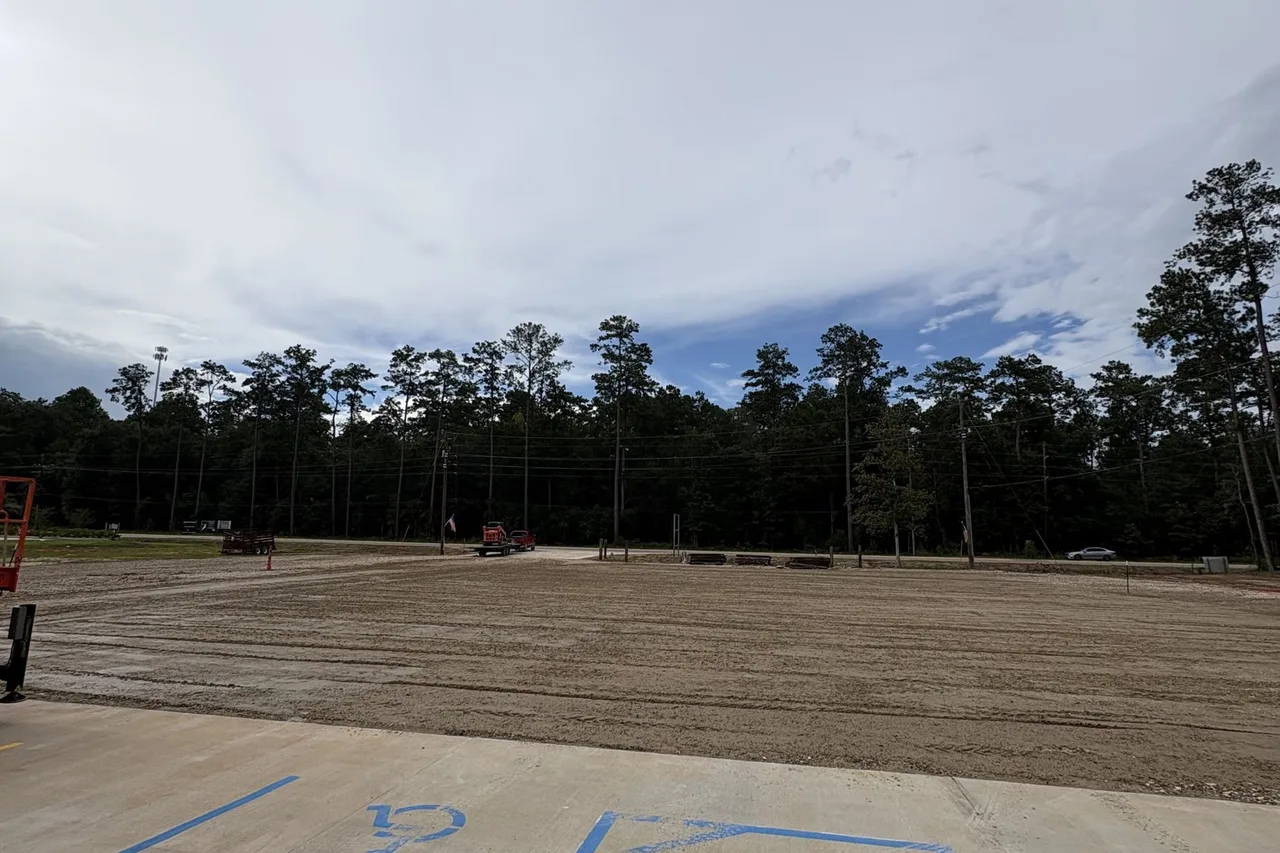
How much does a house pad cost in Louisiana?
A house pad runs about $5 to $30 per cubic yard of fill placed, going by 2026 national cost guides. A 2,000 square foot pad raised 2 feet takes roughly 150 cubic yards. That is about $750 to $4,500 in dirt, before machine time, clearing or grading.
Those are published market ranges, not our price list. We build house pads and building pads out of Hammond. The real number comes off your lot. Pad size, pad height and haul distance move it the most.
What a house pad is
A house pad is a platform of fill dirt, built above the natural ground and packed hard. The slab or the piers sit on top of it. It goes in one layer at a time. Each layer gets compacted before the next one lands. Around Hammond, most pads exist to get the finished floor above the water.
The pad is dirt work. The slab is a concrete trade, published at $4 to $8 per square foot. That is a separate line on your budget. We build and compact the pad, then set the rough grade. Your concrete crew takes it from there.
What a house pad costs
Pads get priced off the parts: dirt, machine time and the work around them. Published ranges put fill dirt at $5 to $30 per cubic yard delivered. A machine with an operator runs $100 to $300 an hour. Leveling and grading the ground runs $1 to $2 per square foot.
| Line item | Published range |
|---|---|
| Fill dirt delivered | $5 to $30 per cubic yard |
| Fill dirt delivered, typical job total | $344 to $1,339 |
| Machine with an operator | $100 to $300 per hour |
| Excavation crew, typical hourly rate | $120 to $150 per hour |
| Leveling and grading | $1 to $2 per square foot |
| Extra dirt work on a sloped lot | $1 to $3 per square foot |
| Moving dirt around on the lot | $1 to $15 per cubic yard |
| Hauling bad material off the lot | $8 to $25 per cubic yard |
| Clearing trees and brush first | $1,400 to $5,800 |
| Soil compaction test | $100 to $125 per test location |
| Land survey | $375 to $750 |
| Permit fees | $100 to $500 |
Sources: HomeAdvisor, Bob Vila, Fixr and Today’s Homeowner.
Machine work usually carries a one day minimum. A small pad and a medium pad can land closer in price than you expect. Leveling is priced by area: one guide puts 2,000 square feet at $2,000 to $4,000.
How many yards of dirt a pad takes
Length times width times height in feet, divided by 27. That gives cubic yards before anything is compacted. The pad runs wider than the slab, since the concrete crew needs room to set forms. Add that shoulder to both dimensions before you do the math.
Say the slab is 40 by 30 feet. Give the pad 5 feet of shoulder on each side. Now you are building 50 by 40, or 2,000 square feet. Raise it 2 feet and that is 4,000 cubic feet, or about 148 cubic yards. Call it 150.
| Pad size | Raised 1 foot | Raised 2 feet | Raised 3 feet |
|---|---|---|---|
| 40 by 30 feet | 44 yards | 89 yards | 133 yards |
| 50 by 40 feet | 74 yards | 148 yards | 222 yards |
| 60 by 50 feet | 111 yards | 222 yards | 333 yards |
Sources: volume math only, length times width times height divided by 27.
Order above the raw number. Fill packs down as it is compacted. The cost guides say to buy a little more than the math calls for. Our fill dirt cost guide covers per yard and per load pricing.
What pushes a pad price up around here
Pad height is the biggest lever on the bill. On a 2,000 square foot pad, every extra foot adds about 74 cubic yards of dirt. Ground condition comes next, then haul distance. A wooded lot adds clearing before the pad can start.
Height is not a guess here. In August 2016, the National Weather Service recorded 20 to 30 inches of rain over parts of Southeast Louisiana. An estimated 50,000 to 75,000 structures flooded. Tangipahoa was one of the parishes hit hardest.
The rest of the money goes here:
- Soft ground. Wet, muddy material comes off the footprint first. Hauling it away runs $8 to $25 per cubic yard.
- Clearing. A grown up lot gets cleared before the pad, published at $1,400 to $5,800.
- Haul distance. Dirt is heavy, so every mile between the pit and your lot is truck time.
- Testing. A lender or engineer may ask for a soil compaction test, $100 to $125 per test location.
- Drainage. Water has to leave the pad instead of standing at the edge. That is land grading work around the outside, priced in our land grading cost guide.
Mobile home pads
A mobile home pad is the same build set to a different target. The home sits on piers, so the pad has to be flat and firm. In Tangipahoa Parish, the height is measured off the frame. The bottom of the steel I beam has to sit at least 12 inches above the base flood elevation.
The home also gets anchored to the foundation system. Cost follows the same math of yards, machine hours and haul distance. Plenty of these pads get rebuilt after an old home comes off the property. That is mobile home demolition first, then a fresh pad on clean ground.
Permits and the rules before the first load
In a mapped flood zone, filling a lot counts as development, and development needs a permit. Federal rules count filling, grading and excavation as development. LSU AgCenter states that all development in a special flood hazard area requires a permit. That is land with a 1 percent or greater chance of flooding in any year.
Tangipahoa Parish runs this through the Permit Office. A flood determination on the property has to be done by that office. The parish keeps elevation certificates on file for all new development. The Hammond office is at (985) 542-2117. The floodplain administrator is at (985) 340-9028.
The rules set the height too. Tangipahoa requires the lowest floor of a new house to sit at least 12 inches above the base flood elevation. Freeboard of 12 or 18 inches above that elevation is common across Louisiana communities. LSU AgCenter notes that buildings in A zones may reach that height on compacted fill. Buildings in V zones may not be supported on fill.
St. Tammany Parish reads the same for Covington, Mandeville and Slidell. All development in the floodplain requires a permit, earthwork included. Fill without one and the parish can make you put the land back at your own cost.
Utilities get located before any machine digs. Louisiana law requires notice to the regional notification center at least 48 hours ahead. The same law caps it at 120 hours, weekends and holidays excluded. Locate requests are free at 811 or 1-800-272-3020.
How long a pad takes
A single house pad on open ground can be a few days. Clearing a wooded lot first adds time. So does digging out soft material and hauling it off. Wet ground moves the schedule here more than anything else. Rain stops the work and softens what is already down.
The order rarely changes. Clearing first if the lot needs it, then the topsoil comes off the footprint. Fill goes in and gets built up in compacted layers. Shaping, rough grade and truck access finish the job.
Send us the address, the pad size and the height your plans call for. We will look at the ground and give you a free estimate on the pad and site prep work. We sell and haul the fill dirt too, so it lands on one bill. Call or text (985) 500-4145, or send the contact form.